
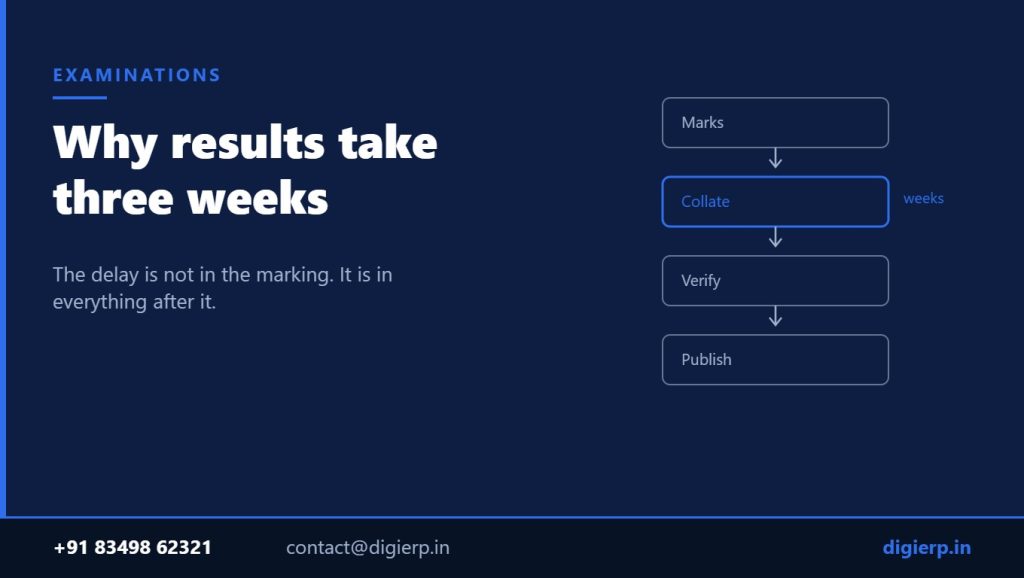
Ask an examination section why results take so long and you will hear about examiners. Ask the examiners and they will tell you they submitted their marks a fortnight ago.
Both are right. The marking is usually the fastest part of the process.
Where the weeks actually go
Between “marks exist” and “results are published” sits a sequence that nobody describes as work, and which consumes most of the calendar.
Collection. Marks arrive as sheets, spreadsheets and occasionally photographs, in different formats, at different times, from internal and external examiners. Somebody chases the last three.
Matching. Each mark has to be tied to the right student. Roll numbers, registration numbers and names do not always agree across documents, particularly for students who changed section or programme.
Merging. Internal assessment sits in one place, practicals in another, the theory paper in a third. They have to be combined per student, per subject, under whatever weighting the regulation specifies.
Eligibility. Attendance shortage, fee dues and pending backlogs all affect whether a result can be declared. Each is held by a different department and has to be asked for.
Verification. Totals are re-checked. Grade boundaries are applied. Moderation is decided and applied.
Approval. The result passes through whatever committee the statutes require before it can be published.
Every one of those steps is a handover, and every handover is a queue.
The re-entry tax
The expensive part is that most of these steps involve re-typing something that already exists in digital form somewhere.
An examiner’s spreadsheet is retyped into the collation sheet. The collation sheet is retyped into the result format. The result format is retyped into the marksheet template. Each re-entry is an opportunity for a transposed digit, which is why verification exists, which is why the process takes another week.
A single wrong mark discovered after publication is far more costly than the entire verification exercise — so the caution is rational. The right response is to reduce the number of re-entries rather than to add another round of checking.
What a connected process looks like
The structural change is that marks are entered once, against the student record, by the person who produced them — and everything downstream reads from that.
Internal marks, practicals and theory accumulate against the same student. The weighting is applied by rule rather than by hand. Eligibility is not requested from three departments, because attendance and dues are already in the same system. Moderation is applied and logged. Approval is a workflow step with a name attached to it.
The marksheet is then generated from the record, not typed from it.
The part that matters when something is questioned
Results get challenged. A student queries a total; a revaluation changes an outcome; an external body asks how a grade was arrived at three years later.
With sheets and spreadsheets, answering means finding the right file and hoping it was the final version. With a system that logs every step, the answer is a record: what was entered, by whom, what moderation was applied, who approved it, and when. That trail is worth more than the speed gain, and it is the part institutions consistently underestimate.
DigiERP handles examinations as part of the same platform as admissions, attendance and fees — mark entry, internal and external components, eligibility drawn from live attendance and dues, moderation and result approval as controlled steps, and marksheets, transcripts and migration certificates generated from the record.
A useful measurement
For the last examination, write down two dates: when the last examiner submitted marks, and when results were published.
The gap between them is not marking time. It is process time, and unlike marking time, it is something the institution controls.
To see how the sequence works in practice, write to contact@digierp.in or call +91 83498 62321. Related: the full university requirement list.