
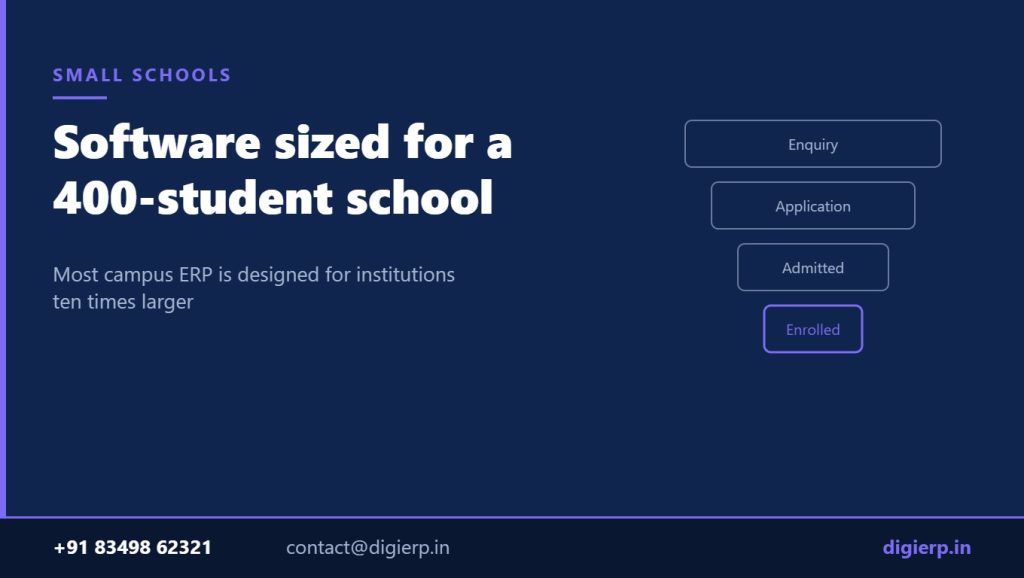
A school with 400 students runs almost the same processes as one with 4,000. Admissions, fees, attendance, examinations, staff, parents, certificates. The work does not scale down; the staff does.
That mismatch should shape what you buy, and usually does not.
Why most campus software fits badly
Most products are built for larger institutions with a defined role per function — an admissions officer, a fee clerk, an examination section. The software mirrors those roles.
In a small school two people do all of it. Software that assumes six specialists creates handover steps between people who are sitting at the same desk, and those steps become clicks that serve no purpose.
What to prioritise
One person must be able to run it. Ask to see the whole admission-to-receipt flow done by a single user. If it requires three logins, it will not work in your office.
Fees above everything. For a small school, fee collection and dues visibility deliver more value than any other module, because cash flow is tighter and follow-up is more personal.
Parent self-service. With a two-person office, every call answered by software is meaningful relief.
Setup done for you. You do not have anyone to spare for a two-month migration. Who loads your existing data, and at whose cost, matters more for you than for a large school.
What you can reasonably skip at first
Elaborate dashboards. Complex approval chains. Role hierarchies that assume a department structure you do not have. Anything requiring a dedicated administrator.
This does not mean buying a cut-down product — it means not being forced into process you do not need. The modules should be there for when you grow; they should not be compulsory on day one.
The pricing trap for small schools specifically
Per-student pricing looks friendly at 400 students and is the thing that hurts most later, because small schools grow in percentage terms faster than large ones. Going from 400 to 600 is a 50% jump in your software bill at exactly the moment you are spending on classrooms and staff.
A flat annual fee is usually the better structure for a school expecting to grow, even where the first-year figure is higher.
A fair word about whether you need this yet
If your school has 150 students, one person who genuinely holds everything, and nothing is slipping — you may not need an ERP this year. Software adds process, and process has a cost in a very small setup.
The signals that it is time: admission season needs temporary help, fee dues cannot be stated without compiling, or parents are calling the office for things they should see themselves.
How DigiERP fits
All 18 modules included, so nothing is withheld for a larger plan, but nothing is compulsory either. Unlimited students, staff and parents on one flat annual contract, so growth does not change the bill. Data migration as part of implementation, and unlimited training — which matters most when you have no IT person.
For a quotation sized to your school, write to contact@digierp.in or call +91 83498 62321.