
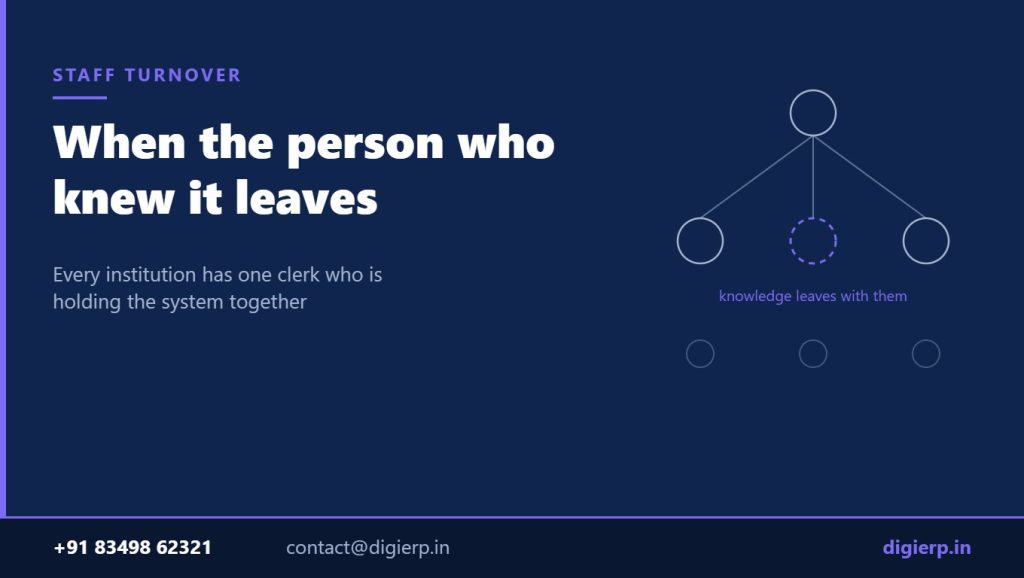
Every college has one. The clerk who knows which file the 2019 admissions are in, which principal signed the concession policy, why Commerce students are numbered differently, and who to call at the university when a marksheet is wrong.
They are usually excellent at their job. They are also, from the institution’s point of view, a single point of failure.
The real operating manual is a person
Most campus processes were never documented. They were learned, adjusted and passed on verbally. The written rule says one thing; the actual practice has twelve sensible exceptions that exist for good historical reasons nobody has written down.
This works remarkably well, right up to the day it does not. The person retires, resigns, takes long leave, or moves to another institution. What leaves with them is not a set of files — the files are still there — but the knowledge of how those files relate to each other.
The replacement is then handed a cupboard and a login and asked to be equally reliable.
What the first six months after a departure look like
Work slows, and nobody can quite say why. Requests that used to take a day take a week. Queries get escalated to the principal that never used to reach the principal.
Small errors appear — a concession applied to the wrong head, a certificate issued in a format the university no longer accepts — because the new person is following the written rule rather than the practised one.
And parallel records start to breed again. The new clerk, not trusting a register they did not build, starts their own spreadsheet. Now there are two versions of the truth, and the next person will inherit both.
Why training alone does not solve it
The standard answer is a handover period, and it helps. But a handover transfers what the departing person thinks to mention, in the weeks they have left, while doing their normal job. The tacit knowledge — the exceptions, the reasons, the “we always check this first” — mostly does not survive the transfer, because nobody thinks to mention what feels obvious to them.
It also does not help at all when the departure is sudden, which is a meaningful share of departures.
What moving knowledge into the system actually means
The aim is not to replace experienced staff. It is to make sure the process does not live only in their memory.
Three things carry most of the weight:
The process is the software. When admission, fee collection, concession approval and certificate issue happen as defined steps in a system, the sequence is enforced rather than remembered. A new clerk following the screens is following the institution’s actual process, not their own reconstruction of it.
Every action has a name and a date on it. When a decision is questioned two years later, the answer is a record rather than an attempt to recall. This matters most for the things that carry risk — waivers, mark moderation, certificate issue.
There is one record, not a cupboard and three spreadsheets. A successor who can search the whole history does not need to be told where things are, and has no reason to start a private copy.
DigiERP is built this way: role-based logins for every staff member, defined workflows for admissions, fees, examinations and certificates, and one student record that every department reads. Staff accounts are unlimited under one flat annual contract, so there is no cost reason to have people sharing a login — which is what destroys the audit trail in the first place.
Training that does not expire
One practical point worth checking with any vendor: what training costs in year two, when the person who was trained has left.
If retraining is billable, institutions ration it, and new staff get taught by whoever is free rather than by anyone who knows the system. That is how a well-implemented system quietly degrades over three years. Training on DigiERP is unlimited and included for exactly this reason.
The question to ask yourself this week
If your most experienced office staff member did not come in tomorrow, how long would it take to answer a parent’s question about a student who joined in 2021?
If the honest answer depends on that one person being reachable by phone, the knowledge is not in your institution. It is in them.
To talk through what moving it across would involve, write to contact@digierp.in or call +91 83498 62321.