
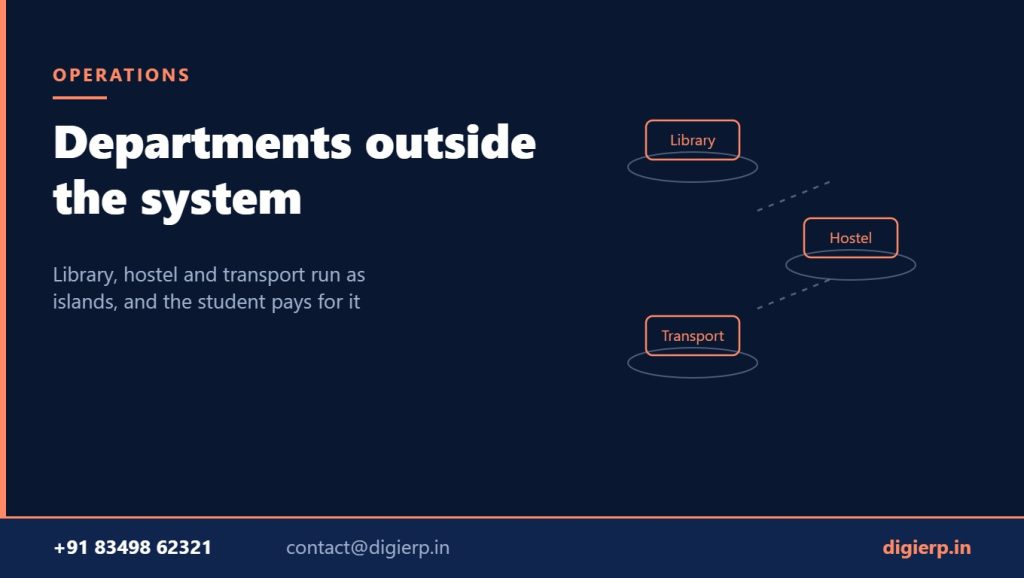
Most institutions that have computerised have computerised the same things: admissions and fees. Sometimes academics. Rarely library, hostel and transport.
It is a consistent pattern, and the reason is almost always the same — those modules were priced separately, and when the quotation had to be trimmed, they were the ones that went.
The decision was rational. The result is not.
Nobody made a bad choice. Faced with a per-module price, a principal reasonably concluded that admissions and fees mattered most and the library could carry on with its register a while longer.
But the value of a connected system comes from the connections. Leaving three departments outside does not remove three-tenths of the benefit — it reinstates the original problem, because those departments still need student data, and now they maintain their own copies of it.
The library keeps its own list of members. The hostel keeps its own list of residents. Transport keeps its own list of route users. Each list was copied from the office at some point and has been drifting ever since.
Where the drift shows up
At admission. Every new student has to be entered again in three more places, which is where those extra entries in the admission-season count come from.
When something changes. A student changes section, leaves the hostel, changes route or discontinues. The office knows. The three islands find out eventually, or do not.
At no-dues. This is where it bites hardest. Before a transcript, a TC or a final marksheet is issued, the student needs clearance from library, hostel, transport and accounts. With four separate registers, that means the student physically walking between four desks, collecting four signatures, on four different days — usually in the week they are trying to leave for a job or a further course.
At reporting. Hostel occupancy, transport utilisation and library usage are all questions an accreditation file or a governing body may ask. Each one becomes a separate data-gathering exercise.
The student experiences it as the institution being slow
This is worth stating plainly. The student does not know or care which module was cut from the quotation three years ago. They know that getting a certificate took a week and required four signatures, and that the hostel had them listed under an old room.
The institution absorbs a reputational cost that was never part of the calculation when the modules were dropped.
What connecting them actually gives you
Nothing exotic. Library issue and return run against the same student record, so membership is not a separate list and no-dues is a status rather than a signature. Hostel allocation, room changes and vacating are recorded against the student, so occupancy is current. Transport route and stop are attached to the student, so utilisation is visible and a route change reaches the parent portal.
Clearance then stops being a walk between desks. It is a screen showing what is outstanding, in which department, for that student.
Why pricing is really the root cause
The reason this pattern is so consistent across Indian institutions is that most campus software is sold per module. That model makes the partial implementation almost inevitable, and the partial implementation is what preserves the fragmentation the software was bought to remove.
DigiERP includes all 18 modules — library, hostel, transport, inventory and the rest — in one flat annual contract, with unlimited student, staff and parent accounts. Not as a generosity, but because leaving departments outside is precisely how institutions end up paying for software and still doing the reconciliation by hand.
A question for your next review
List the departments that hold their own copy of your student list. Then ask what happens in each of them when a student changes section in November.
The departments where the honest answer is “somebody tells them, usually” are the ones costing you more than the licence you saved.
To see how the full set fits together, write to contact@digierp.in or call +91 83498 62321. Related: all 18 modules explained and how pricing works.