
Are you looking for an affordable education ERP for your institution but unsure where to begin? Most colleges do not need to digitise everything at once. They need to start in the right order.
Institutions that struggle with an ERP rollout usually did not choose badly. They switched things on in an order that did not build on itself, so each module needed data the previous one had not captured yet.
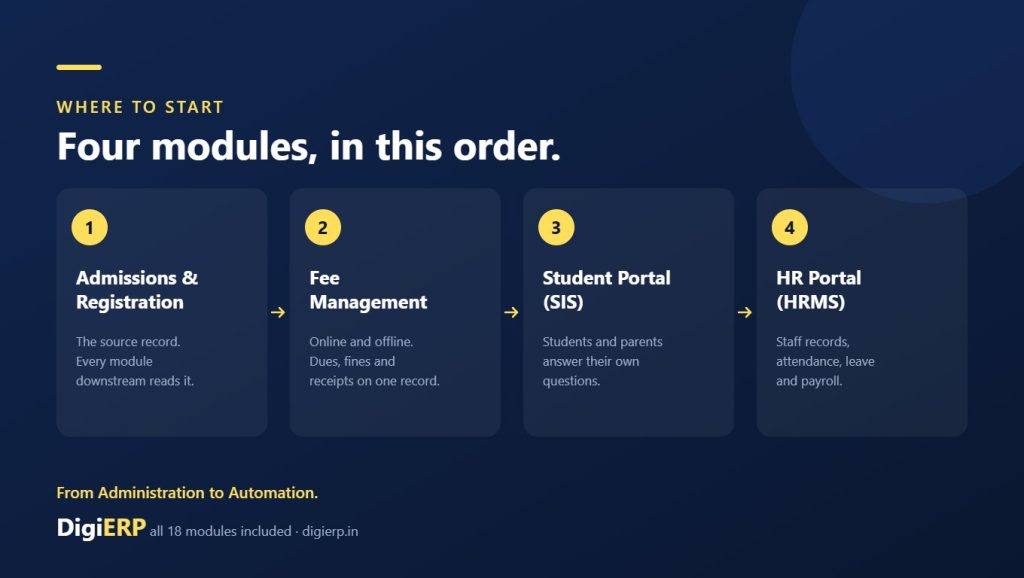
These four modules, in this sequence, cover what almost every institute actually needs first.
1. Admissions and Student Registration
This comes first because everything else reads from it. The student record created at admission is what fees, attendance, examinations, the portal and the reports all depend on. Start anywhere else and you spend the year typing the same names in again.
Done properly, the application itself becomes the student. Enquiry, form, merit list, seat allotment and enrolment all sit on one record, so when a student changes course or category, nothing has to be corrected in four places.
This is also the module that pays for itself fastest, because admission season is when offices are stretched thinnest.
2. Fee Management, online and offline
Fees come second because they are the first thing management asks about and the first thing parents ask about.
Fee structures are defined once, per course and category. After that, allocation, instalments, concessions, fines and receipts follow automatically for every student. Payments come in online through a gateway or over the counter in cash, and both land on the same student record, so the day’s collection is one figure rather than two systems to reconcile.
Online collection matters for a practical reason beyond convenience: money arrives earlier in the session, and the office spends less of its year chasing it.
Every Fee. Every Student. Under Control.
3. Student Portal (Student Information System)
With admissions and fees in place, there is finally something worth showing students and parents.
A student portal lets them see their own attendance, marks, fee dues, receipts and notices without telephoning the office. Parents get the same view for their child. This does not sound like an efficiency measure until you count how much of a clerk’s day is spent answering questions that already have an answer sitting in a system.
It also changes the institution’s relationship with parents, who stop finding out about attendance shortfalls or unpaid dues at the end of the term.
4. HR Portal (HRMS)
The fourth module turns to the staff side: teaching and non-teaching records, attendance, leave applications and approvals, and payroll.
It comes fourth deliberately. It is the one part of this list that does not depend on student data, so it can wait until the student side is running — and by then your team has learned the system on the modules they use daily.
Once HR is in, the institution has both halves of its record in one place, which is the point at which reporting to management, a governing body or an accreditation team stops being a collection exercise.
From Administration to Automation.
Why the order matters more than the list
Most institutions already know they need these four. What causes trouble is starting with examinations or library before there is a reliable student record to attach them to, or running fee collection in one system while admissions sits in another.
Build the record first. Attach money to it. Then open it to the people it describes. Then bring the staff side in.
What this costs with DigiERP
Nothing extra. All eighteen modules are included in a single flat annual maintenance contract, with unlimited student, staff and parent accounts. The sequence above is about the order you switch things on, not the order you pay for them.
That distinction matters, because institutions that buy modules one at a time end up doing exactly what this article warns against: running two systems while they wait for the budget for the third.
Where to begin
If your institution is starting this journey, the fastest way to judge it is to watch the first module handle your own admission process rather than a demonstration script.
Write to contact@digierp.in or call +91 83498 62321 and we will show you exactly that.