
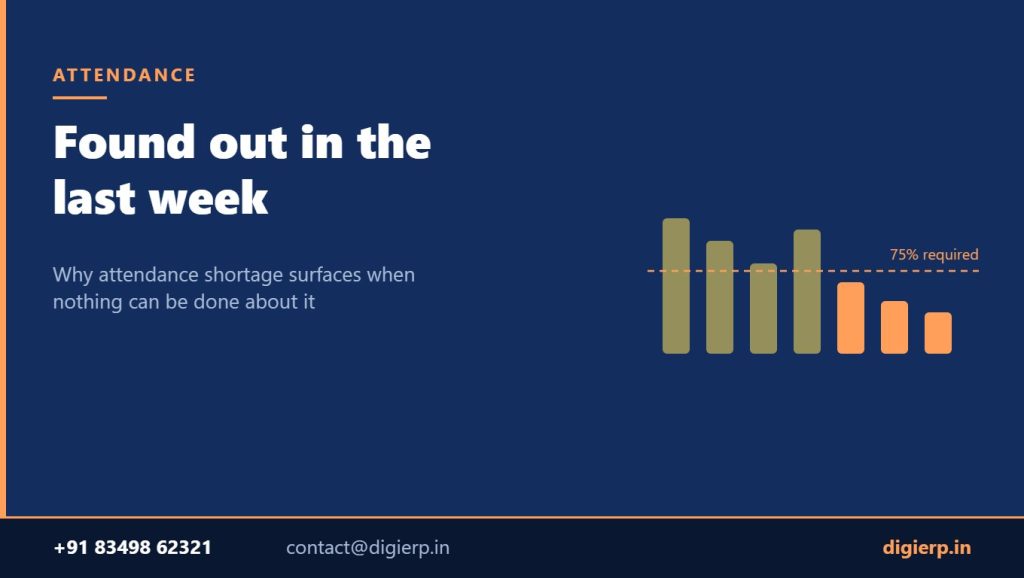
Three weeks before the examination, the department adds up the attendance registers. Fourteen students are below the required percentage. Letters go out. Parents arrive. Somebody looks for a rule that allows condonation.
Every one of those fourteen students was heading there since September. Nobody knew, because nobody adds up a register until they have to.
The gap between recording and knowing
This is the whole problem in one line: attendance is recorded daily and totalled once.
The lecturer marks the register in class. That is diligent, and it happens. But a register is a record, not a calculation. Until someone sits down with a calculator at the end of term, the institution holds the raw material for an answer without holding the answer.
Meanwhile the student knows roughly that they have missed “a few” classes, the parent knows nothing at all, and the tutor knows only about their own subject. Nobody is looking at the total, which is the only number that matters.
Why the late discovery is expensive for everyone
For the student, three weeks out is too late to fix. There are not enough classes left to bring the percentage up. The only remaining options are condonation, a medical certificate, or losing the term.
For the parent, it lands as a shock, and often as a grievance: why is this the first we are hearing of it? It is a fair question, and the honest answer — that the numbers were not added up until now — does not reflect well on the institution.
For the office, it creates a fortnight of meetings, letters, appeals and exceptions at exactly the moment the examination section is busiest.
And for the institution as a whole, it builds a habit of granting exceptions, which quietly erodes the rule everyone is supposedly enforcing.
The second problem: attendance is trapped in the department
Even where attendance is totalled regularly, the figure usually lives inside the department that keeps it. Examination eligibility needs it. The parent portal needs it. The accreditation file needs it two years later. Each of those gets a separately prepared copy, and the copies drift.
That is why a student can be told one percentage by the department and see a different one on a notice board.
What changes when the total is continuous
Nothing about teaching needs to change. What changes is that the register is kept in a system that adds up as it goes.
The moment attendance is marked, the running percentage updates. A student at 71% in October is visible in October, not in March. The tutor sees their group. The head of department sees the programme. The parent sees their own child, without phoning anyone.
That single change moves the conversation from punishment to prevention. A parent contacted in October can still do something. A parent contacted in March can only argue.
It also removes the copies. Examination eligibility reads the same attendance record the lecturer marked. So does the parent login. So does the report you will need for accreditation. There is nothing to reconcile because there is only one record.
The practical objection, answered
The usual objection is that lecturers will not mark attendance in software. Sometimes that is true, and it is worth taking seriously rather than dismissing.
Two things make it work in practice. The marking has to be faster than the paper register, not slower — a class list that opens in a few taps, not a login process. And it should not require anyone to do the job twice; marking on paper and entering later is the arrangement that always collapses.
In DigiERP, attendance marking, examination eligibility, the parent portal and reporting all read one record, and staff and student accounts are unlimited, so there is no per-user reason to keep any class outside the system.
A question for your next department meeting
Ask what today’s attendance percentage is for one specific student in one specific programme. Not last term’s — today’s.
If the answer requires somebody to add up a register, the shortages in that programme will be discovered late again this year.
To see how this works on your own data, write to contact@digierp.in or call +91 83498 62321.