
A parent calls the office and asks what is still due. The clerk checks the fee register and says eighteen thousand. The parent says they paid nine thousand online last Tuesday.
Both of them are telling the truth.
The money arrives in four different places
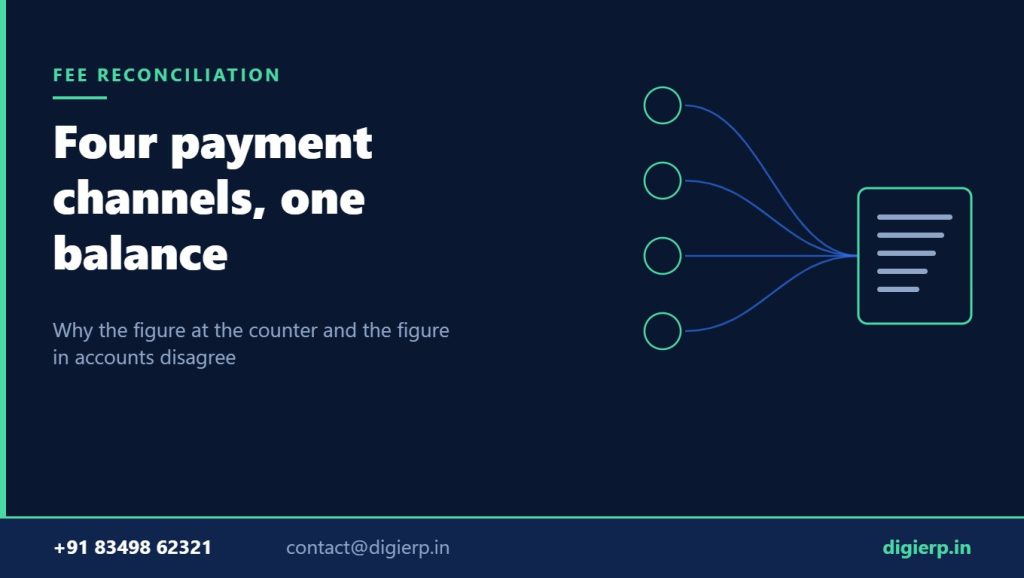
An Indian college typically collects fees through at least four channels, often in the same week. A payment gateway or UPI. Cash at the counter. Cheques and demand drafts. Direct bank transfers from parents who prefer it.
Each channel lands somewhere different. The gateway settles into the bank account two or three days later, with a statement line that may not carry the student’s name. Cash goes into a receipt book, then into the register. Cheques clear whenever they clear. A bank transfer shows up as a reference number that has to be matched to a human being by hand.
Somebody in the office is holding all of that together mentally, and doing it well most days. The problem is that the arrangement depends on that person, and on nothing going wrong in a busy week.
Why the two numbers differ
Almost every fee dispute traces back to a timing gap or a matching gap.
Timing: the parent paid on Tuesday; the settlement reached the bank on Thursday; the register was updated on Friday. For three days the institution’s own record said something untrue, through nobody’s fault.
Matching: the transfer arrived with a reference the office could not tie to a student, so it sat in a suspense list. The parent has a receipt from their bank. The college has money it cannot attribute. Both records are accurate, and they do not agree.
Scope: the accounts ledger records fee heads. The fee register records students. A concession, a scholarship adjustment or a late fee waiver applied in one place often does not travel to the other.
What this costs beyond the argument
The visible cost is the time spent reconciling — a job that grows with enrolment and peaks exactly when the office is busiest.
The less visible cost is that management cannot see its own collection position. Ask how much is outstanding this month, by class, and in most institutions the honest answer is “give us two days”. By the time the figure arrives it is two days old, and decisions about follow-up, about cash flow, about when to release a payment, are all being made on stale information.
The third cost is trust. A parent who has been told the wrong balance once treats every future figure as negotiable. Staff start keeping their own private notes as protection, which quietly adds a fifth record to the four you already had.
What actually fixes it
The fix is not more careful reconciliation. It is removing the need to reconcile, by making every channel post to the same student ledger at the moment it is recorded.
In practice that means: online payments write straight to the student’s ledger through the gateway integration rather than being typed in later. Cash and cheque receipts are issued from the same system that holds the ledger, so issuing a receipt is the act of recording the payment. Bank transfers are matched once, against a student, and stay matched.
Once that is true, there is only one balance. The counter, the accounts desk and the parent’s own login are reading the same number, because there is only one number to read.
The reports that become possible
When payments live in one ledger, questions that used to take two days become a query: collection today, this month, this year; dues by class or by programme; who has paid part and how much remains; which concessions were applied and by whom.
Automatic reminders also become honest. A reminder sent from a system that knows about the payment made yesterday does not embarrass you in front of a parent who has already paid — which is the reason many institutions stop sending reminders at all.
This is how fee management works in DigiERP: one student ledger, every channel posting into it, with daily, monthly and yearly collection views, class-wise and overall dues, receipts issued from the same record, and reminders that read live balances. It sits inside the same system as admissions and academics, on one flat annual contract with no per-student charge.
One test before you change anything
Pick a student who paid online in the last week. Ask how many minutes it takes to prove, from your own records, exactly what they have paid and what remains — and whether the counter and accounts would give the same answer.
That number is your reconciliation problem, measured.
To see this running on data like yours, write to contact@digierp.in or call +91 83498 62321. Related: all 18 modules explained.