
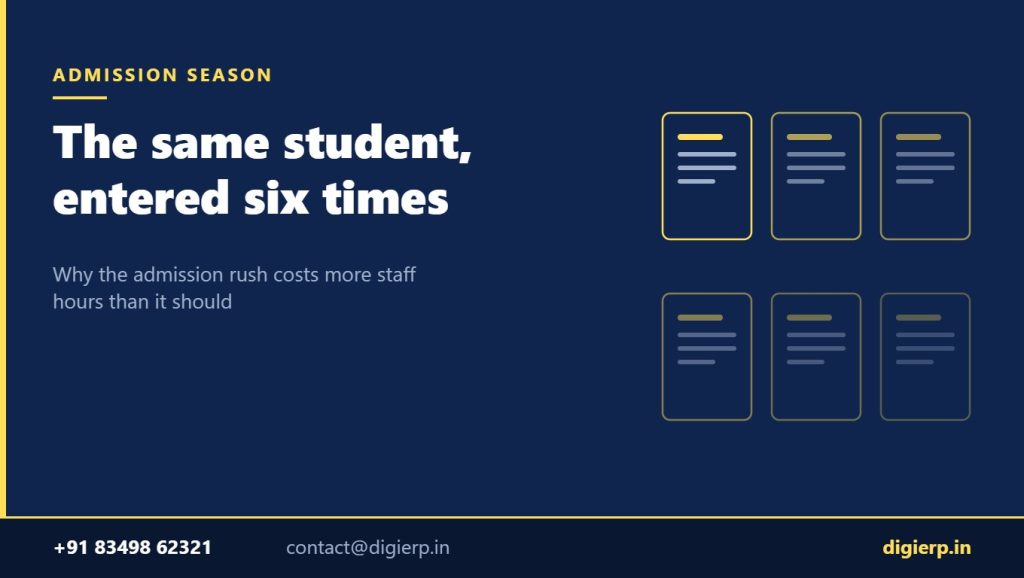
Ask a college office how many places a single student’s name is written during admission, and watch them count on their fingers. The answer is rarely fewer than five.
The admission form. The admission register. The fee receipt. The department register. The attendance sheet. An Excel file, because the register cannot be searched. Sometimes a seventh, for the university return.
It is the same name every time, typed by a different person each time.
Nobody designed it this way
This is worth saying plainly, because offices often feel defensive about it. No registrar sat down and decided that student details should be recorded seven times. It grew.
Each register was started by somebody who genuinely needed information they could not easily get from the existing ones. The head of department could not get a class list quickly, so the department began keeping its own. Accounts could not see who had actually joined, so accounts kept a parallel sheet. Every one of those decisions was sensible on the day it was made.
Ten years later the institution has eleven places a student’s name can live, and no way to make them agree.
Where the hours actually go
On an ordinary day in November this is invisible. It shows up in the six weeks of admission season, when the same small team has to enter several hundred students into several places each.
So the office stays late. Many colleges hire two months of temporary help. Many pull a lecturer off teaching and put them behind a desk. None of that appears as a software cost anywhere in the budget, but it is paid in salary every single year.
Then the second wave arrives, and it is worse than the first: the registers start to disagree. One says the student is in Commerce, another says Management. One has the corrected phone number, the others have the old one. Somebody now has to compare two records and decide which is right, and that comparison takes longer than the original entry did.
The cost nobody writes down
Ask most principals what the office costs and they will say salaries. That is the visible part.
The hidden part is hours spent typing something that already exists somewhere else, hours spent reconciling two lists, hours on the phone telling a parent a fee balance that somebody had to look up in three places first. These never appear as a line item, but they are bought and paid for every month.
There is a second cost that is harder to price. During admission season the office is the institution’s shop window. A parent standing at a counter while three people search for a form is forming an opinion about how the college is run. Sometimes that opinion decides the admission.
The fix is structural, not clerical
The instinct is to solve this with effort: better training, a stricter format, one more checking step. That treats the symptom, and every extra check adds work to the same overloaded weeks.
The structural fix is that details should be entered once, and everything else should read from that entry. The application form becomes the student record. The fee receipt reads from it. The department list reads from it. The attendance register reads from it. Nothing is re-typed, because there is nothing to re-type.
When that is true, the second and third entries stop being needed, and so does the checking — there is no longer a second version to check against.
What it looks like in practice
An enquiry is captured when the parent first calls or walks in. That enquiry becomes an application. The application becomes an enrolled student. Each stage adds information to one record rather than creating a new one.
From that point the fee counter, the department, the examination section and the parent portal are all reading the same row. Correct a phone number once and it is correct everywhere, because there is only one place it was ever stored.
That is how DigiERP is built — one connected system across all 18 modules rather than separate software per department. Pricing is a single flat annual contract with unlimited student, staff and parent accounts, so there is never a cost reason to leave a department outside the system, which is how the fragmentation started in the first place.
A question worth asking before next season
Pick one student who joined last year. Ask your office to list every place that student’s name is written, and how many people typed it.
The answer usually surprises people, and it is a better basis for a decision than any feature list.
To see how this works on data shaped like your own, write to contact@digierp.in or call +91 83498 62321. Related: the buyer’s checklist for Indian colleges and what switching involves.