
Almost every college office in India runs Tally. It keeps the books, it satisfies the auditor, and the accountant knows it inside out. Nobody is looking to throw it away.
The problem is not Tally. The problem is that fee management was never what Tally was built for, and most institutions end up doing that work twice.
What accounting software is actually for
Tally is built around vouchers, ledgers and statutory books. It answers questions an auditor asks: what came in, what went out, under which head, in which period. For that work it is very good, and there is no reason to replace it.
But a college’s fee questions are different in shape. They are not about the institution’s accounts. They are about one student.
Where fee management is a different job
Consider what a fee clerk actually needs to answer on a normal morning:
- What is this student’s fee structure, given their course, year and category?
- Which instalments have they paid, and which are due this month?
- Does a concession or scholarship apply, and has it been deducted correctly?
- What late fine has accrued, and from which date?
- Has their branch change altered what they owe for the rest of the year?
None of those are ledger questions. They are student questions, and answering them from an accounting system means holding the student’s story somewhere else — usually a register, usually an Excel sheet.
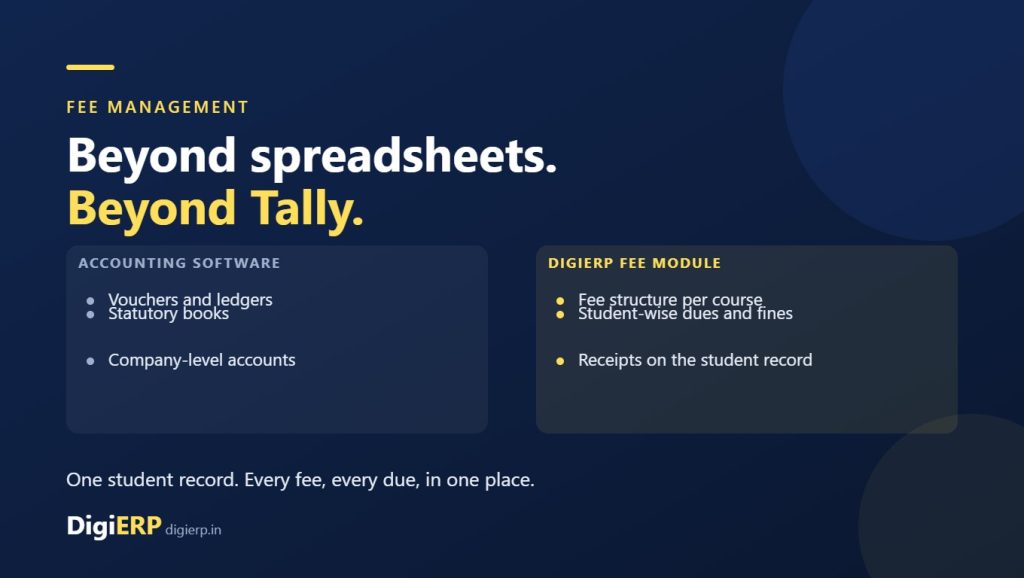
Beyond Spreadsheets. Beyond Tally. Built for Education.
The double entry nobody planned
This is where the real cost sits. The receipt is written for the student, then entered again into Tally for the accounts. Two records of the same payment, made by two people, at two different times.
Most of the time they agree. When they do not, somebody spends an afternoon finding out why. At the end of the year, when collection figures have to match the books, that afternoon becomes a week.
And because the student side lives in a register, nobody can produce a list of defaulters by course without building it by hand first.
What DigiERP does instead
DigiERP holds fees against the student record rather than against a ledger account.
Fee structures are defined once, per course and per category. After that, allocation, instalments, dues, concessions, fines and receipts are calculated for every student automatically. A receipt issued at the counter updates that student’s balance immediately, because there is only one place the balance lives.
Because fees sit on the same record as admissions, attendance and examinations, a change in one place is reflected everywhere. A student who changes branch mid-session has their remaining fees adjusted without anyone rebuilding a sheet.
So do you still need Tally?
Many institutions keep it, and that is a perfectly reasonable decision. Statutory accounting, payroll and vendor payments are accounting work, and accounting software does them well.
What changes is that Tally stops being the place where student fees are tracked. It receives the totals instead of holding the detail. The clerk stops maintaining a parallel register, the accountant stops reconciling two versions of the same collection, and the principal can see outstanding dues by course without asking anyone to prepare it.
What it looks like day to day
A parent calls to ask what is pending. The answer is on one screen, in seconds, with the payment history beside it.
The management asks for collection against target for the current session. It is already there, by course and by category, not three days away.
Admission season arrives and fee entry does not double, because entering the student was the fee entry.
See it against your own numbers
The fastest way to judge this is to take one course, with its real fee structure and its real concessions, and watch the system handle it.
DigiERP works with colleges, universities and multi-campus education groups across India, on one flat annual contract that includes all eighteen modules with unlimited student, staff and parent accounts. Write to contact@digierp.in or call +91 83498 62321 to arrange a demonstration.